

It once felt unattainable to stumble upon an artist so blatantly on the verge of stardom, let alone be sitting beside her on one of Seattle’s many scruffy curbs, unfolding a crumbled piece of paper with hand-written interview questions scribbled on its college-ruled lines (an amateur detail she graciously dubs “cunty”).
Thavoron’s night had been nothing short of an enlightening success. Her mid-August performance at Neumos had offered a glimpse into a fresh era defined by divine femininity and sensuality through her unique lens, and a predictive stepping stone to what will someday be referred to as her origin story. Advocating for representation as a Cambodian-American and trans artist herself, she participated in an all femme-fronted, BIPOC-fronted benefit show for the Lavender Rights Project, joining the lineup alongside fellow Seattle-based acts like Rainbow Jackson and The Hues, GENEVA, and MANISHA.
LOUD BARK Magazine
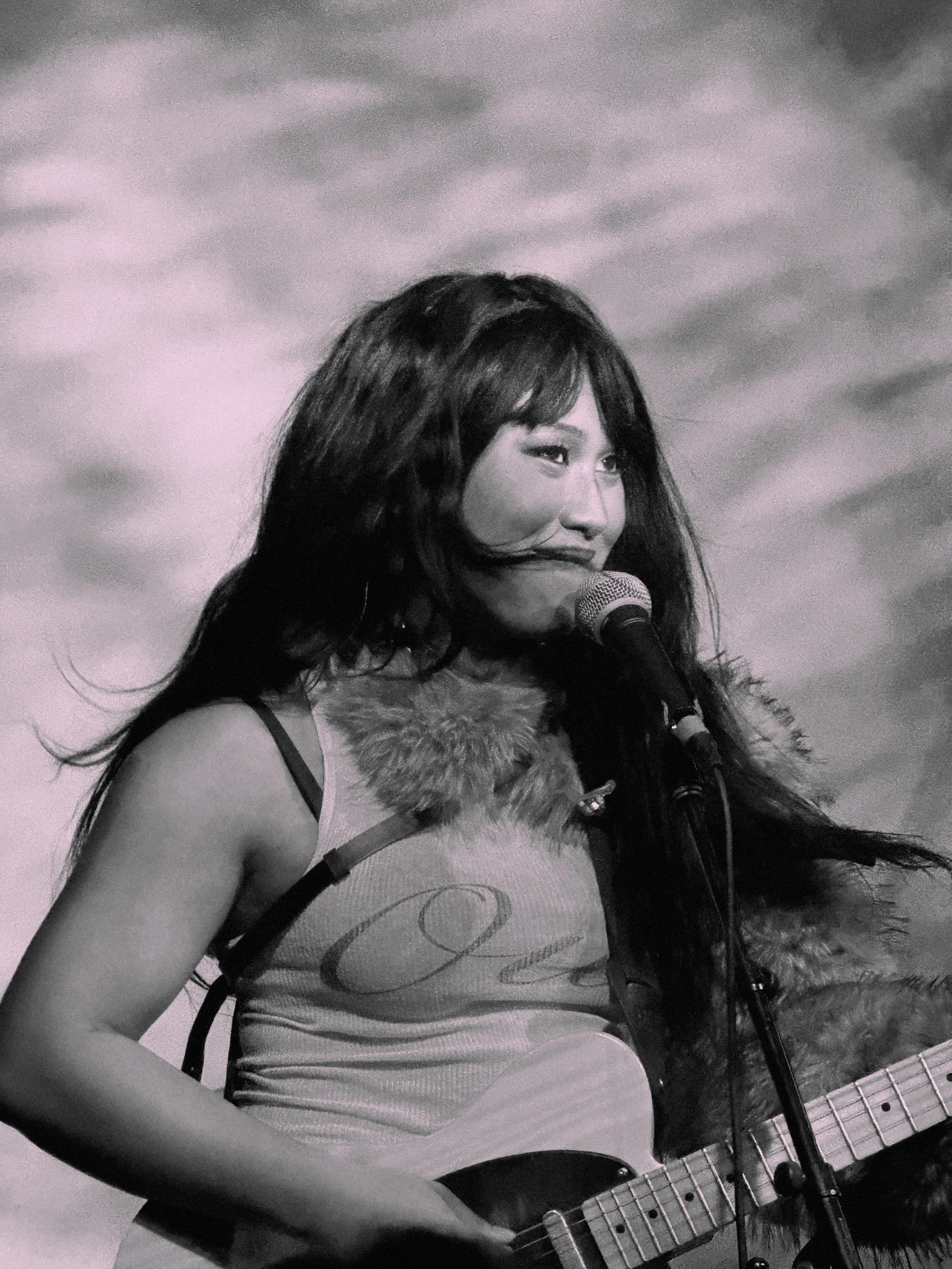
Beneath hazy pink and purple lights, the multitalented musician introduced new and forthcoming tracks with the ripened comfortability of someone who’s made themselves at home on stage. Judging by the constant cheers of encouragement and steadily propped-up phone cameras of the awestruck concertgoers, her magnetism was palpable, executed by a raw, emotional vocal delivery and sensually crafted movements that synced with the live band’s instrumentation.
Traditional markers of fame and celebrity be damned—Thavoron doesn’t need any of it to hold an audience in the palm of her hand.
“This is the most fun I’ve had at a show in a while, thanks to all my friends,” her words resonated smoothly between songs, and through my wide-eyed captivation, I realized even her speaking voice is pretty.
Thavoron’s content energy remained post-show, twinkling as she leisurely moved through the low-lit crowd of friendly faces, stopping to hug and chat with those who've shown up to support the cause—before thoughtfully ensuring we snagged an interview. With her gentle guidance as to where the conversation should take place (the sidewalk just across the street from the venue), it’s very early on that I begin feeling like the younger sister she’d later lightly refer to me as.
Now, the 25-year-old has settled herself down into a side-ward position on the concrete, having changed out of her ‘Diva’ tank and red leather mini-skirt into a dark, breathable nightie. She patiently hits her vape as I prepare my recording, every movement of hers notably easy and casually self-assured.
To see Thavoron on stage is witnessing a skilled star with a powerful sense of self. To have a conversation with her is understanding the meld of self-discovery and spiritual alignment it takes to reach that point.
ELIZA: You just performed at Neumos in support of the Lavender Rights Project. Why is this cause important to you?
THAVORON: Honestly, it's just to give back to anything that is supporting our queer community. It's just in any shape, way or form that I can help, I'm down. And so yeah, donating all of the proceeds from tonight is going to be really special. And I think it really allowed me to let go of my ego and know that me performing is for something larger and grander than me while also simultaneously being such an important part of me and my identity.
ELIZA: What’s been your favorite part of performing?
THAVORON: Honestly, I would have to say presenting my music the way that I want to. Having full control of having a narrative or a vision, being able to hone in on that through choreography or through the live band sounds. I find all of it to be so fascinating and fun. And so yeah, I guess just my favorite part about performing is really just presenting my music the way that I want to. And also feeding off of the energy of people that like it. And even the people that don't because it just makes me go 10 times harder.
ELIZA: I’m interested to learn about the choreography because you do so much of it in your music videos. Did you grow up a dancer?
THAVORON: I didn't grow up a dancer, but I've always wanted to dance. But I've been singing ever since I was little. And I remember when I was younger, my mom, or I told her, I was like, "I want to do dance classes." And she was like, "Why would you do dance classes? You're a singer." And I was like, "Okay."
ELIZA: You could’ve been a pop star! You’re well-rounded.
THAVORON: Literally. But yeah, I didn't grow up doing dance, but I did competitive cheer for three years in high school. So that's where the choreography comes from. Or an understanding of it, I guess.
ELIZA: You kicked off this new era with Attitude and Blurry Tattoos. Can you say a little bit about this upcoming album? How would you describe the themes and sound? How does it compare to past work you've done?
THAVORON: Honestly, I actually feel good about talking about it right now in terms of timelines. So the new album, I just really wanted it to be kind of, I guess, sonically a culmination of everything I've ever been inspired by in my entire life. And so just really being able to hone in and have focus on the intersections between alternative indie singer-songwriter music and alternative R&B and throwback R&B because that's what I grew up on.
ELIZA: Do you have an idea for a release date yet? Or a ballpark?
THAVORON: Either by the end of this year or earlier next year.
ELIZA: Oh my God, I'm so excited. Before you released Attitude, the last time you released music in 2024 was with your self-titled album. I mean, what changes within that span of almost two years with your artistry? Are you going into this new era with a different mindset, perspective, or creative process?
THAVORON: Yeah, I think honestly, with my self-titled, it just serendipitously aligned with my transition. And the album cover with the long hair and everything femme. We shot that months before I even came to terms with my gender identity. And so it was weird to have that signifier and something beyond me that I already knew even before I transitioned. But I really came to terms with it after a shroom trip actually. But the time in between, I think with this album, my self-title was so diaristic and introspective and truly focused around my life. But I think this new album is really honed into my divine femininity and my wisdom, I guess, that I've picked up on these last few years, truly from just living as a point of reference. And yeah, all of these songs, I feel like they're pretty generally broad and accessible, but it's still all very personal to me.
THAVORON: But this feels like my true and proper debut. Even though I've been releasing music for so long, this is the album where I'm like, this is me and this is what I believe in morally and sonically.
ELIZA: Yes. And I think you can tell–as a listener–it’s definitely a shift. All of your stuff is amazing. And you can hear little bits of who you are now in past work where you're like–
THAVORON: Yeah! And I've always been afraid to fully lean left, I guess. And I don't know, making indie folk singer songwriter, people would always tell me that they liked it. And so I was like, okay, I guess this is the box that I need to live in. But then I kind of was like, wait, I don't need to live in any box actually.
ELIZA: Well, especially living in Washington State, that’s a very popular genre.
THAVORON: Yes. And it's hard to feel not, I don't know, outcasted, I guess, if you're not just random or just a stereotypical rock band from Seattle, just in the same vein of everyone else. And so I was kind of leaning on that for a long time. And then I started to realize that the thing that makes me and my artistry special is my perspective and the things that are important to me. So I've truly just foregoed everything else.
ELIZA: Throughout your discography, as you've reflected on past relationships, you've compared yourself to a “stain” or something that lingers or haunts. At a certain point, can such constant brutal introspection begin feeling more draining than it does liberating?
THAVORON: That's a really good question. For me, I think the feeling itself is already draining, but being able to put it into a song is something that feels kind of finite and it can be done in a way. And so I think that's why when I write, it's so important to me to just honor all of the feelings and in order to make space for the new.
ELIZA: Do you have a routine to decompress after particularly heavy writing sessions?
THAVORON: Yeah. If I'm ever in a reset phase, I'm DND for like 24 hours, truly just nonverbal in my room. I'm actually such an introspect at heart, I guess. Or introvert, I mean. But a lot of people are surprised by that. But in order for me to be out in the world and an extrovert, I need to recharge and just, I don't know, recharge my energy. Like in order for me to be able to pop out and do shit like this.
ELIZA: You have a song called 18 where you grapple with nuanced themes relating to love and personal identity. If you could tell your 18-year-old self anything–or other 18-year-olds who are reading this, going through similar things–what would you tell them?
THAVORON: I'm going to channel this at my 18-year-old self, but it's applicable to 18-year-olds. But I would say that it's really okay that you don't have everything figured out. I always felt like the clock was ticking for so long and it already ran out of time by the time that I was 19. But I'm really starting to realize that there's so many things that I have yet to learn and do and feel and all of this stuff. And so I think my main message I would give to my younger self is just always remember and know who you are and don't be so hard on yourself.
ELIZA: Do you think who you were then would be able to imagine that you'd get to this point?
THAVORON: Yeah.
ELIZA: Oh good. That reminds me of when we were texting—you’d mentioned having “faith” and I thought that was interesting. What is your relationship with faith?
THAVORON: I'm someone that is very spiritual and my gut feeling is my superpower and my true sense of discernment always. And I'm always trying to connect with something higher than me. When I do that, it makes all of the small things feel really small.
ELIZA: Well, it's obvious that you have a very clear vision of who you are. Even with this new era–I've listened to your whole discography–and I just feel like with these past two releases, it's so honed in on your identity, who you are becoming.
ELIZA: Looking into the future, what would your dream venue be to play at?
THAVORON: Oh my God. My dream venue, one of them has always been Red Rocks. I would say MSG, but some crazy shit has been happening, so maybe not there. Anywhere that would have me. I would love to play any random festivals, like Primavera Sound is up there like Glastonbury. Anywhere where all of my greats have played. I would love to play.
ELIZA: Do you have any artists that you dream to collaborate with someday?
THAVORON: I would love to work with Blood Orange or Kelela or Twigs. Yeah, they're up there.
ELIZA: I know Twigs is one of your influences. Do you have influences that maybe people wouldn't expect? Maybe you like them for their songwriting and it's just total heavy metal.
THAVORON: Yeah. Let me think. Daughter and London Grammar. I grew up on 2013 Tumblr, so I was there for all of the indie alternative movements. Yeah, I would say them or The xx. They are really good at leaving space in their music, which I've always resonated with.
ELIZA: That is noticeable in your recent sound. It really adds to the overall sensuality.
THAVORON: Yeah, for sure.
ELIZA: And I'm curious, what does success look like to you personally? At what point do you think you're going to look at your music career and think:Wow, I've made it?
THAVORON: Honestly, for me, not having to work at a restaurant anymore. I think that is the main thing. And yeah, I don't know. Also playing at the intersection of fashion and music. I think that would be one of the telltale signs that I've made it, I guess. Or yeah, I would say doing that because that's always been such an inspiration and dream of mine.
ELIZA: Do you have a favorite fashion designer? Maybe a local one here in Seattle?
THAVORON: I don't have a favorite designer, I would think, but my favorite runway show ever is YSL Fall, Winter 2013. For the music, they collaborated with Cherry Glazer, which is this indie rock band from LA. And that was one of the first times where I was like, music can decorate things like fashion as well as time. And just that collection paired with the music, it was just really affirming. And I was like, this is what a vision is.
ELIZA: A true performance.
THAVORON: Literally! Yeah.
ELIZA: When people look back at this era of your career, what do you hope they'll appreciate about your artistry?
THAVORON: That I've always been myself. And I think that coming into yourself more doesn't take away from you coming into yourself. You know what I mean? It's like those things are not mutually exclusive. I've just always followed what felt right to me at the time. And that's something that I will never feel bad about or take for granted.
ELIZA: You sound very intuitive. And I think that–because I'm quite spiritual too–you must feel lucky that you're born being open-minded to that kind of stuff.
THAVORON: No, that’s why we connect.
ELIZA: We’re on the same plane.
THAVORON: Yeah, seriously.
ELIZA: Now—is there anything I didn't ask that you think is important for people to know?
THAVORON: I don't know. Maybe that I produce everything myself. It's so important for me to be in the driver's seat. And that's just another step of, I don't know, having control of the vision, I think. I've worked in studios and I've worked with producers and sometimes it just doesn't feel right, but sometimes it feels so right. And so it's a really play by your scenario, I guess. But I'm really proud of the production skills that I've been able to learn and develop over the entirety of my career. And yeah, it all started on GarageBand, like on my MacBook Air.
ELIZA: Like it does for all the greats.
After years spent self-analyzing, constantly digging into tender wounds to extract the leftover bullet fragments of her past, this emerging era is Thavoron, healed. Her spirituality seems to put her on a higher plane of being, as if she’s observing life from a bird’s-eye view, while her wisdom gained from years of this deep internal exploration has aligned her with a sense of self many others are unfamiliar with—especially before the age of 30.
From her soulful production to her confessional lyricism, her performance abilities to her proud identity, Thavoron’s mere artistic existence within the alternative music landscape holds significance that transcends the present moment. Her backstory is a prophetical tale so many of us have heard before pertaining to successful creatives (though a star burns just as brightly even when no one’s gazing up at the sky) and one day, without a shadow of a doubt, it will be her turn.